
 EN
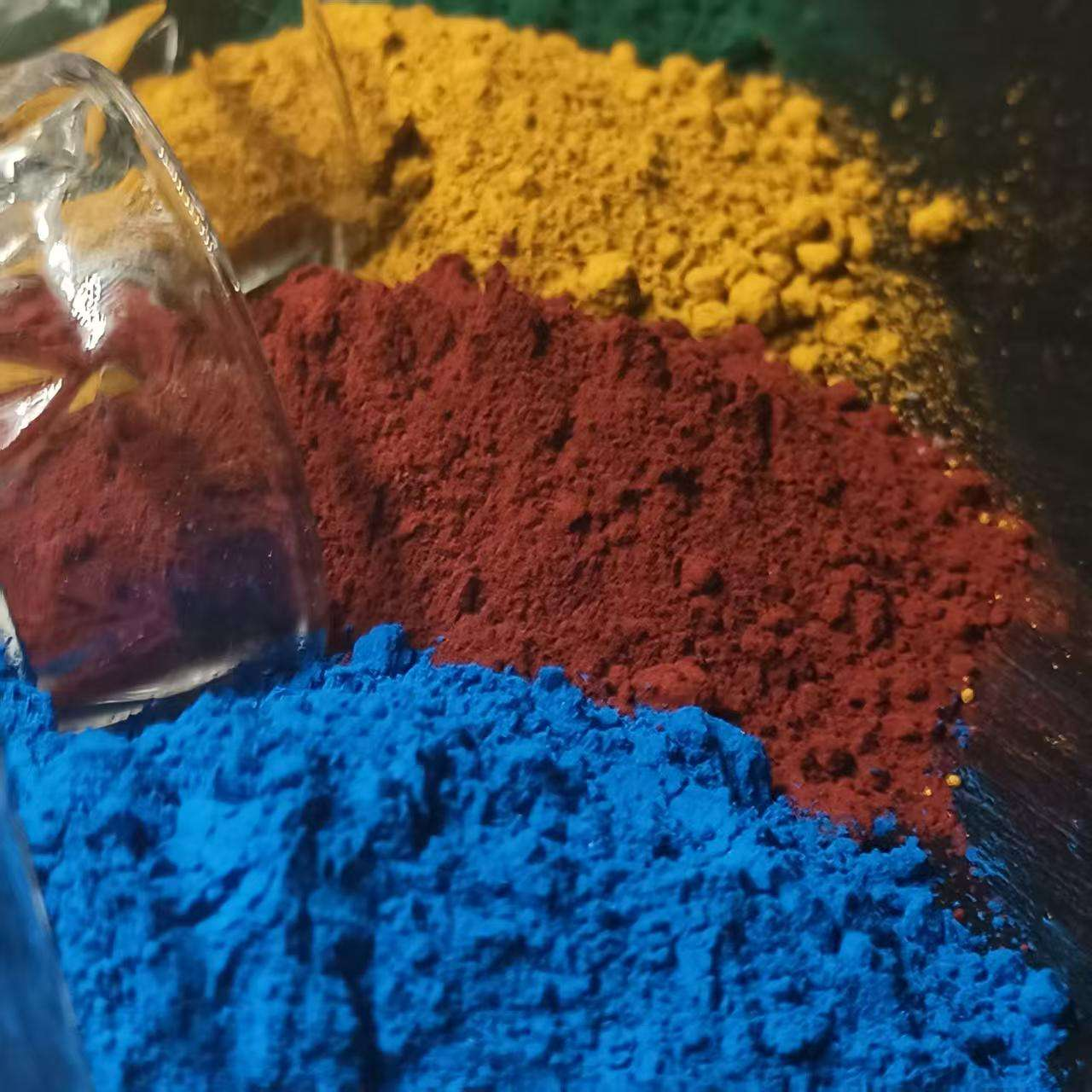
Why Iron Oxide Pigments Are the Standard for Concrete Coloring
Chemical Stability and UV Resistance of Fe₂O₃, Fe₃O₄, and FeOOH in Alkaline Cement Environments
Iron oxide pigments dominate integral concrete coloring because their inorganic crystal structures remain inert in the alkaline cement matrix. Fresh cement paste has a pH exceeding 12—conditions that rapidly degrade organic colorants through hydrolysis or leaching. The three common iron oxide phases—hematite (Fe₂O₃), magnetite (Fe₃O₄), and goethite (FeOOH)—resist alkali attack and do not react with calcium silicate hydrate (C-S-H) or other hydration products. As a result, color remains fixed: no bleeding, shifting, or migration during curing. Their UV resistance is equally critical: sunlight degrades most organic dyes within years, but iron oxides retain chromatic integrity for decades—even on exposed flatwork, precast panels, and façades. Because color arises from bulk crystal structure—not surface coatings—tinting strength stays consistent after prolonged UV exposure, minimizing long-term color drift.
ASTM C979 Compliance: How Purity and Particle Size Distribution Prevent Batch-to-Batch Color Drift
ASTM C979 defines minimum performance requirements for concrete pigments: lightfastness, alkali resistance, and insolubility. But compliance alone doesn’t ensure uniformity. Batch-to-batch color variation most often stems from inconsistent purity and particle size distribution. High-purity synthetic iron oxides deliver tightly controlled tinting strength; a pigment labeled “95% Fe₂O₃” may still contain inert fillers or impurities that dilute chroma. Similarly, finer, narrower particle size distributions disperse more completely and yield higher chroma per unit weight. A coarser or polydisperse shipment—even at identical dosage—can produce lighter, mottled, or uneven color. Specifying ASTM C979-compliant pigment with documented tint strength and particle size limits (e.g., D₅₀ ≤ 0.8 µm) enables producers to hold a consistent color target across truckloads and days.
Optimizing Iron Oxide Dosage for Predictable, Uniform Color
The 2–8% Weight Threshold: Balancing Tinting Strength Against Cement Hydration Interference
Accurate dosage must be calculated as a percentage of cementitious material weight—not total concrete weight. For architectural applications, 2–8% by weight of cementitious content strikes the optimal balance between chroma development and mix stability. Below 2%, pigment concentration is too low to mask natural cement variability; minor batching errors become visually apparent. Above 8%, excess fine particles absorb water, delay hydration, reduce workability, and can compromise compressive strength—with diminishing returns in color saturation. In practice, 6–8% achieves deep, reliable chroma in most mixes, while 10% is widely regarded as the upper safety limit. Use this formula:
Pigment weight = (Total cementitious weight × Dosage %) ÷ 100
Always pre-blend pigment with fine aggregate or use a slurry to avoid localized overdosing, and verify scale calibration regularly. Maintain constant water-to-cement ratio in trials—extra water lightens cured color and undermines reproducibility.
Calibrating Dosage by Oxide Type: Why Red Iron Oxide Requires Less Than Yellow or Black for Equivalent Chroma
Tinting strength varies significantly by iron oxide chemistry—so dosage must be calibrated by type, not habit. Synthetic red iron oxide (Fe₂O₃) has a dense hematite lattice and high intrinsic chroma, typically achieving full saturation at 2–4% of cement weight. Yellow iron oxide (FeOOH) contains bound water and exhibits lower tinting strength, commonly requiring 4–6% for equivalent visual depth. Black iron oxide (Fe₃O₄) falls between them, often needing 4–7%, depending on surface area and dispersibility. Finer grades further reduce mass-based dosage requirements due to increased surface area. Always validate dosage changes with small-scale trials using production-matched water-cement ratio, mixing time, and curing conditions—never assume linear equivalence across oxide types.
Ensuring Dispersion Uniformity to Eliminate Mottling and Streaking
Uniform color begins with complete pigment dispersion. Agglomerated particles survive mixing and appear as dark streaks or pale mottling in hardened concrete. Two factors most directly influence dispersion consistency.
Pre-Wet Dispersion vs. Dry-Blend Sequencing: Impact on L*a*b* Consistency (CV < 3%)
How pigment enters the mix determines dispersion quality. Dry blending—adding pigment directly to dry cement or aggregate—can yield acceptable results but frequently leaves micro-agglomerates, especially with ultrafine oxides. Pre-wet dispersion suspends pigment in water (and optionally a compatible dispersant) before batching. This wets particle surfaces, breaks weak clusters, and promotes even distribution before hydration begins. Color uniformity is best quantified in CIELAB space (L* = lightness, a* = red-green, b* = yellow-blue). Producers using pre-wet methods routinely achieve coefficient of variation (CV) under 3% across multiple batches—well within the threshold for visually uniform surfaces. Dry blending without optimized wetting often pushes CV above this level, increasing risk of streaking—particularly on troweled, stamped, or polished finishes.
Mitigating Agglomeration in Ready-Mix Delivery: Mixing Time, Shear Intensity, and Admixture Compatibility
Agglomeration can reoccur during transport or mixing, creating specks or swirls. Three variables control this risk. First, mixing time must be sufficient after pigment addition: at least 60–90 seconds at full drum speed once all materials are charged. Second, shear intensity must be high enough to break agglomerates—but excessive shear can entrain air or fracture aggregate. Third, admixture compatibility is critical: certain water reducers, superplasticizers, or air-entraining agents alter particle charge or suspension stability, promoting settlement or flocculation. Always pre-test the full pigment–admixture–mix sequence before production. If using a color slurry, maintain agitation during transit to prevent sedimentation. These controls preserve dispersion integrity from batch plant to placement—ensuring the final surface reads as one cohesive tone.
Maintaining Color Uniformity Across Large-Scale Projects
Large pours magnify minor variations into visible shade differences across slabs, walls, or pavements. To ensure continuity, lock key variables before the first truck arrives: pigment source, dosage, water-cement ratio, finishing method, and curing protocol. Pre-qualification panels poured with the exact cement, aggregate, and admixture blend establish an approved color window—and reveal how finishing techniques (e.g., troweling pressure or timing) affect surface tone.
Reserve a single production lot of iron oxide pigment for the entire phase or structure. Even pigments meeting identical specifications can vary subtly between manufacturing runs due to raw material sourcing or calcination profiles. Store pigment in a dry, climate-controlled environment, isolated from moisture and humidity. Use automated weigh-batching—not manual bag-counting—to eliminate dosage drift.
Control water and finishing as an integrated system. Excess water lightens color, increases efflorescence risk, and exacerbates mottling; over-troweling darkens and burnishes the surface. Set and enforce a maximum water-cement ratio, monitor aggregate moisture daily, and standardize finishing equipment, passes, and timing. Curing method must also remain consistent: switching from moist curing to membrane-forming compounds alters early-age moisture loss and final hue.
At each placement, retain representative test cubes or small panels marked with pour number and date. If color mismatch emerges later, these samples allow side-by-side comparison under standardized lighting. For critical architectural work, quantify variation using a handheld spectrophotometer: ΔE < 1.0 is widely accepted as a practical threshold for visual uniformity—but the acceptable ΔE value must be defined and agreed upon in the specification prior to construction.
FAQ Section
Why are iron oxide pigments preferred for concrete coloring?
Iron oxide pigments are preferred due to their chemical stability in alkaline cement environments, resistance to UV degradation, and ability to preserve color integrity long-term.
What is ASTM C979 compliance?
ASTM C979 is a standard specifying performance requirements for concrete pigments, including lightfastness and alkali resistance. Compliance ensures quality and uniformity in coloring.
What is the recommended iron oxide dosage for concrete?
The recommended dosage is 2–8% of cementitious material weight. Dosages beyond this range can lead to uneven color or compromise concrete strengths.
How can dispersion issues be minimized?
Pre-wet dispersion techniques and adequate mixing time help break pigment agglomerations, ensuring uniform distribution and consistency in color.
How can color uniformity be maintained in large-scale projects?
Standardize key variables such as pigment source, water-cement ratio, and curing methods, and conduct small test pours to establish acceptable color ranges before production starts.